

The rich text element allows you to create and format headings, paragraphs, blockquotes, images, and video all in one place instead of having to add and format them individually. Just double-click and easily create content.
A rich text element can be used with static or dynamic content. For static content, just drop it into any page and begin editing. For dynamic content, add a rich text field to any collection and then connect a rich text element to that field in the settings panel. Voila!
Headings, paragraphs, blockquotes, figures, images, and figure captions can all be styled after a class is added to the rich text element using the "When inside of" nested selector system.
What if workflow software could give you back 15 hours per week while eliminating the errors that cost you customers?
I've been tracking something interesting over the past six months while working with organizations implementing workflow automation. The gap between companies thriving with these tools and those struggling has nothing to do with budget, team size, or industry…
I’ve found that it usually comes down to three decisions they make in the first 30 days.
Will you…
I’ll come back to these questions shortly.
Here's what I've seen across successful implementations:
Here's where most people get it wrong…
They assume implementing workflow software means months of planning, expensive consultants flying in from the coasts, and a painful transition where everything breaks before it gets better.
I'm always curious about why this myth persists when the reality looks completely different. Organizations seeing transformational results deployed their platforms in under 10 minutes without requiring any technical expertise from their teams. The software I've been building at StartingPoint operates on a principle where no task requires more than five clicks to complete.
Right now, things are exciting because the barriers have disappeared. You're probably imagining resistance from your team who don't want to learn new systems, budget conversations with leadership who question the ROI, or implementation timelines that stretch into next year.
Those obstacles don't exist anymore in the way you think they do.
You know that knot in your stomach when you think about fixing your workflows? That anxiety about making things worse before they get better? If this article dissolves even part of that fear, take notice. It's telling you something important about what's possible now!
Last quarter, I sat down with the Executive Director of a workforce development organization operating across dozens of offices nationwide. She walked me through their challenge: "Our core departments were drowning in requests. Communication happened through email threads that disappeared into inboxes. Workflow existed only in people's heads. When someone went on vacation, their work just stopped. We had no visibility into what was happening across our organization."
What I've learned from watching hundreds of implementations is that success or failure gets determined by three decisions organizations make before they even start using the software.
I'm fascinated by how organizations approach this choice. Some leaders see workflow software as an opportunity to consolidate 8-10 disconnected tools into one unified platform, while others view it as just another application to add to their existing chaos.
The organizations achieving 60% productivity gains take the consolidation approach. They eliminate their separate CRM, project management tool, helpdesk system, file storage solution, and communication platform in favor of one integrated workflow automation system.
Companies that treat workflow software as "one more tool" end up creating additional work instead of reducing it. Their teams now switch between nine tools instead of eight, information still lives in silos, and the workflow software becomes abandoned within 90 days because nobody wants to log into yet another platform.
For me, this decision reveals whether leadership understands workflow automation or just thinks they're buying task management software!
When I speak with successful implementations, they describe spending their first week mapping how work actually flows through their organization. Not how they wish it flowed or how the org chart says it should flow, but how it really happens.
They identify every handoff point… every approval bottleneck, every place where things currently fall through the cracks. Then they build those workflows into the software from day one with automated routing, escalation rules, and accountability tracking.
Organizations that skip this step just start using the software without any structure. They create tasks randomly, assign work haphazardly, and wonder why nothing improves. Six months later, they blame the software for failing when the reality is that they never implemented actual workflow automation at all.
It's always interesting to see how organizations handle this question. I’ve found that some leaders make workflow software optional out of fear that forcing adoption will create resistance.
Then I see others mandate that all work flows through the platform from day one.
The mandatory approach wins every single time. When adoption is optional, high performers use the system while everyone else continues working through email and spreadsheets. Information fragments across multiple systems, leadership still can't see what's happening, and the benefits of automation just never materialize!
What I find remarkable is that organizations that force adoption report less resistance than those making it optional. When everyone uses the same platform, collaboration becomes easier rather than harder because all communication, files, and tasks live in one place.
I'm focused on this because optional adoption creates a two-tier organization where some people operate efficiently while others drag the whole team down with their manual processes.
Over two decades of implementing enterprise systems, I've watched organizations sabotage themselves with remarkably consistent patterns. These approaches sound reasonable in planning meetings but create disasters in practice.
I see this constantly with technical leaders who want to configure every setting, build custom fields for every data point, and create elaborate automation rules before anyone has used the basic system.
They spend three months in setup mode, building complexity that nobody asked for and solving problems that don't exist. By the time they roll it out to users, the platform is so complicated that adoption fails immediately.
What actually works is…
When I observe failed implementations, there's usually an IT person or operations manager "in charge" who doesn't actually perform the daily work that needs automation.
They build workflows based on how they think work happens rather than how it actually happens. The people doing the work discover that the system doesn't match their reality, workarounds emerge immediately, and adoption craters.
Successful implementations put power users from each department in charge. The people who actually do the work design the workflows that support their work.
I'm usually amazed when companies run training sessions that teach users "how to create a task" and "how to upload a file" without ever explaining the actual workflows they'll be using.
Employees learn button-clicking but not how their daily work should flow through the platform. They return to their desks confused about what they're supposed to do differently.
Organizations that succeed train on complete workflows…
People learn by doing their actual work, not by memorizing features.
With failed implementations, many leaders ignore the goldmine of performance data their workflow software generates.
The platform shows exactly where bottlenecks exist, which team members are overloaded, which processes take too long, and where quality issues emerge. But nobody looks at the dashboards or acts on the insights.
I've always sensed that organizations treating workflow software as just a productivity tool miss the bigger opportunity here. The real value comes from continuous optimization based on the performance data the platform surfaces automatically.
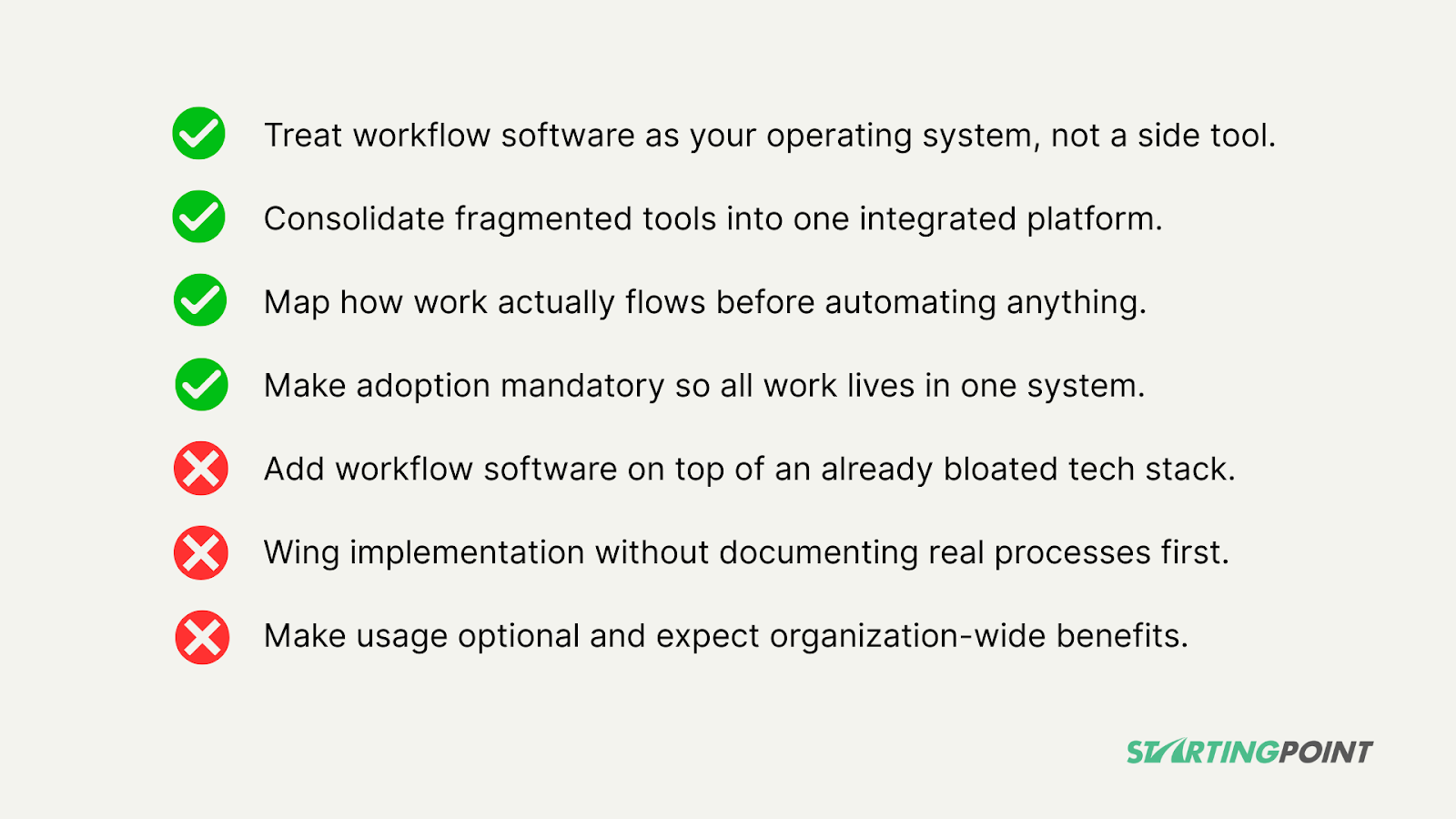
I want you to treat workflow software as your next operating system rather than just a side tool.
I'm interested in what separates transformational implementations from mediocre ones. The pattern isn't about features or pricing but about how organizations approach workflow automation fundamentally.
The highest-performing organizations I work with run their entire operation through their workflow platform.
Every customer interaction, internal request, project milestone, file, and communication flows through the system.
Leadership can see organizational health at a glance. Team members know exactly what they're responsible for and when it's due. Customers experience consistency because documented workflows ensure nothing falls through the cracks.
When workflow software becomes your operating system, you don't need separate tools for CRM, project management, helpdesk, file storage, or team communication. Everything lives in one place where it's searchable, reportable, and automated.
Successful implementations pursue automation… aggressively! If a task repeats more than three times, they build a workflow template for it. When a decision follows consistent logic, they implement automated routing rules.
Within six months, these organizations have automated 70-80% of their routine work. Their teams spend time on high-value activities that require human judgment while repetitive tasks happen automatically in the background.
I think you’ll be shocked at how much capacity this creates. The same team that was drowning in administrative work suddenly has bandwidth to pursue strategic initiatives because automation eliminated the busywork.
For me, the defining characteristic of successful organizations is their commitment to thoughtful workflow design. They redesign how work flows to…
They map every process from end to end, identify improvement opportunities, and build optimized workflows into the platform. Client onboarding that used to take 12 hours of manual work now happens in 90 minutes through automated workflows that gather information, create tasks, notify stakeholders, and track progress without human intervention.
I'm usually impressed by how the best implementations combine workflow automation with knowledge management. As they build workflows for common processes, they simultaneously create documentation, FAQ entries, and self-service resources.
When someone has a question, they find the answer in the knowledge base instead of interrupting colleagues. And if someone needs to complete a task, they access the template and instructions without reinventing the process.
I want you to think about combining automated workflows and searchable knowledge because this will reduce the risk of interruptions dramatically while ensuring consistency across the organization.
What I've observed in transformational implementations is a culture of data-driven optimization. Leadership reviews workflow analytics weekly, identifies bottlenecks, and makes adjustments based on actual performance metrics rather than assumptions.
They spot which processes take longer than they should, which team members need support, which clients are at risk, and where quality issues emerge before they become major problems.
Companies that optimize based on workflow data consistently outperform those making decisions through guesswork or waiting for problems to escalate into crises.
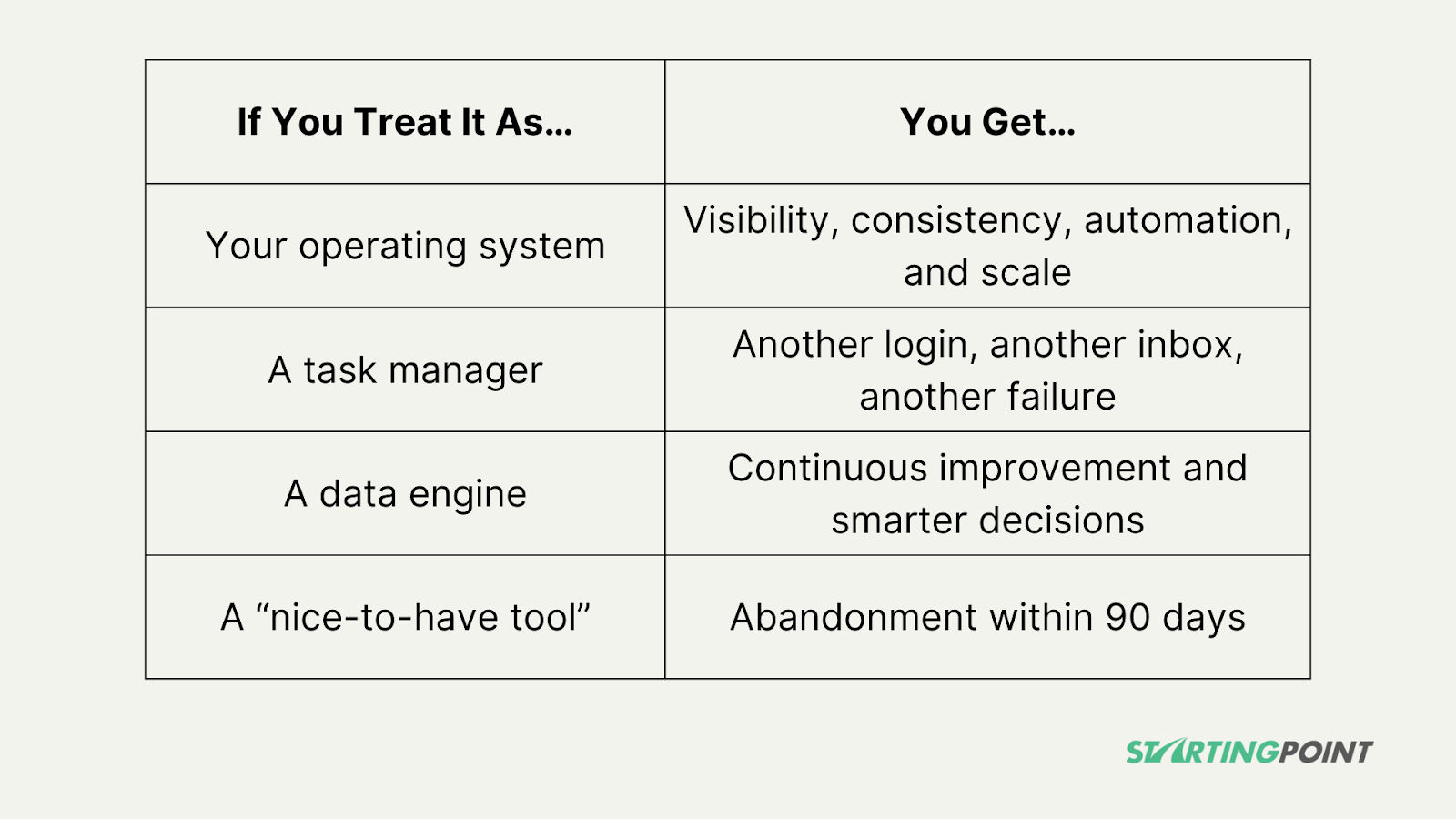
If you treat your workflow software as an operating system, you get visibility and consistency at scale.
I'm passionate about solving a specific problem that I've watched organizations struggle with for two decades. They know they need workflow automation, but every option in the market either costs a fortune, requires months to implement, or demands technical expertise they don't have.
Building StartingPoint came from serving on the board of trustees at Resolute Academy Charter School and watching talented administrators drown in manual processes. I saw the frustration when information lived in scattered email threads and requests fell through the cracks because nobody had visibility.
For me, spending 20+ years implementing enterprise systems at Verisign, Neustar, State Farm Insurance, and other large organizations showed me what enterprise workflow automation could do. But it also showed me the enormous gap between enterprise capabilities and what small to mid-sized organizations could actually access.
That gap now drives me! StartingPoint delivers enterprise-grade workflow automation in a platform that deploys in 10 minutes, requires zero technical expertise, and costs a fraction of traditional enterprise software.
When I watch a 15-person consulting firm implement the same automated workflows that took six months and hundreds of thousands of dollars at a Fortune 500 company, that's when I know we've built something meaningful.
I'm thinking about the organizations I spoke with in January 2025 who said "we're not ready yet" or "maybe next quarter" when discussing workflow automation.
Twelve months later, they're still operating the same way…
And their best people are burning out from the same administrative chaos that existed a year ago.
Meanwhile, their competitors who implemented workflow software in early 2025 have transformed.
They're serving 40% more customers with the same team size and winning business faster because their operations actually support growth instead of choking it.
These teams are also retaining talent because people want to work in efficient environments instead of dysfunctional ones.
What I've come to understand is that delaying this decision doesn't keep you where you are. It moves you backward relative to everyone else moving forward.
The gap widens every month. Companies with workflow automation keep optimizing, keep improving, keep building on their foundation. Companies without it keep fighting the same fires, reinventing the same wheels, and losing ground they don't even realize they're losing.
For me, the question isn't whether workflow automation makes sense. Every organization I work with confirms that it does. The question is whether you'll implement it while you still have a competitive advantage to protect or after you've already lost it to faster-moving competitors.
StartingPoint exists because I believe small and mid-sized organizations deserve access to the same workflow capabilities that enterprise companies have used for decades to dominate their markets.
Request a free trial today. The organizations implementing workflow software right now will look back in 12 months grateful they didn't wait. I hope you're one of them.


