

The rich text element allows you to create and format headings, paragraphs, blockquotes, images, and video all in one place instead of having to add and format them individually. Just double-click and easily create content.
A rich text element can be used with static or dynamic content. For static content, just drop it into any page and begin editing. For dynamic content, add a rich text field to any collection and then connect a rich text element to that field in the settings panel. Voila!
Headings, paragraphs, blockquotes, figures, images, and figure captions can all be styled after a class is added to the rich text element using the "When inside of" nested selector system.
What if a shared services model could cut your operational costs by 40% while delivering faster, better service across every department?
Organizations implementing effective shared services models in 2026 are operating fundamentally differently than they did even two years ago.
They've stopped treating administrative functions as necessary evils scattered across departments and started building them as strategic assets concentrated in specialized hubs.
The numbers tell a story that's hard to ignore…
These are actual results from organizations that restructured how support functions operate.
Most of the teams I work with start seeing savings between 15% and 30% on their delivery costs shortly after they get their shared services model up and running.
Setting up a modern shared services model happens faster than you think. Organizations seeing these results deployed their systems in under 10 minutes without requiring technical expertise from their teams.
What I've learned from implementing these systems is that expensive external consultants aren't necessary, ongoing work doesn't get disrupted, and complex training programs become obsolete when you choose the right platform. These solutions operate on a simple principle where completing any task takes no more than five clicks.
The barriers you're imagining probably don't exist, whether that's months of restructuring departments, staff revolt against centralization, painful learning curves for new processes, or technology budgets that require board approval.
Modern shared services implementations have moved past all of that.
After reading this article, if you feel relieved knowing that your operational chaos can be solved without the complexity you've been dreading, I want you to take this as a sign to request a free trial of StartingPoint.
Last year, I watched some teams hesitate while their competitors cut administrative overhead in half. Those same teams are still stuck carrying duplicated effort across every location.
I recently sat down with a Chief Operating Officer at a multi-location nonprofit organization.
She walked me through their operating model: five regional offices, each running independent HR, IT, and finance operations. Her revelation stopped me: "Ray, we discovered that our smallest office spends 40% of one person's time just on payroll processing. Our largest office dedicates two full-time people to the exact same task. When we calculated the total hours across all locations, we were spending the equivalent of 4.5 full-time positions on payroll alone. For 200 employees."
What I've observed across hundreds of organizations is that you're not just paying for the same function multiple times across different locations but an exponential penalty that compounds with every additional site, department, or business unit you add.
I find it fascinating how the mathematics of duplication creates a multiplier effect that most leaders fail to calculate. Take a seemingly simple function like processing employee onboarding. One location handles 50 new hires annually and dedicates 100 hours to the task.
That seems reasonable until you realize five locations are each dedicating 100 hours to develop their own onboarding materials, checklists, and training protocols. You're not spending 100 hours but 500 hours to accomplish what a centralized function could handle in 120 hours with better consistency.
What strikes me most isn't just duplicated effort but the expertise gap that decentralization creates. When each location processes payroll occasionally, nobody becomes an expert. When one centralized team processes it constantly, they spot errors faster, handle exceptions better, stay current on regulatory changes, and optimize workflows continuously.
I'm particularly concerned about the visibility problem this creates. Decentralized operations mean fragmented data. You can't benchmark performance across locations because everyone tracks differently.
You can't identify best practices because you don't know they exist. Strategic decisions about where to invest or divest become guesswork because you're operating with incomplete information from incompatible sources.
I've watched plenty of organizations attempt to centralize operations, and the patterns of failure are remarkably consistent. They adopt approaches that sound logical in conference rooms but create chaos in practice.
When I speak with organizational leaders, they often describe rushing to consolidate functions without first examining whether current processes deserve preservation. Taking existing workflows from five different locations and simply moving them into one centralized team creates chaos rather than efficiency.
The unit inherits broken processes from multiple sources, standardization becomes impossible because every location insists their variation is necessary, and service quality degrades because the centralized team drowns in incompatible requests from different business units.
Here's what actually happens…
Teams spend more time navigating conflicting procedures than they ever spent managing decentralized operations. The promise of efficiency through consolidation evaporates when you centralize dysfunction instead of excellence.
I'm usually surprised when leaders tell me about launching centralized units without proper systems to support them. Creating a centralized HR, IT, or finance function seems straightforward until requests start flooding in from every corner of the operation.
Teams maintain spreadsheets to track requests, rely on email as the primary communication channel, make status updates through manual phone calls or meetings, and document nothing consistently.
The unit transforms into a bottleneck where requests pile up because tracking systems don't exist, accountability disappears because nobody knows who's responsible for what, and leadership operates blind because reporting happens manually if it happens at all.
It's always interesting to see companies create centralized units but allow individual departments to continue operating their own parallel functions. Leaders believe this creates healthy competition and gives business units choices.
Centers struggle to demonstrate value because departments bypass them entirely, economies of scale never materialize because adoption remains optional, and centralized teams can't build expertise because volume stays too low to justify specialization.
This produces the worst possible outcome. Companies bear the cost of maintaining both centralized and decentralized functions while achieving none of the benefits of either model.
I've always sensed that launching initiatives with a singular goal of reducing expenses creates problems down the line. Headcount reduction drives every decision in these scenarios while quality becomes secondary to achieving budget targets.
Companies save money on the spreadsheet but lose it through poor delivery, internal customers grow frustrated with slow response times and impersonal interactions, and business units start working around the center, recreating the very duplication you sought to eliminate.
This approach ultimately costs more because business units hire shadow staff to compensate for inadequate support, which defeats the entire purpose of consolidation.
I'm focused on governance structures because without them, units lack clear service level agreements, performance metrics, or escalation procedures. Leaders assume goodwill and common sense will guide operations, which rarely proves sufficient.
Teams lack clarity about priorities when multiple urgent requests arrive simultaneously, business units have no recourse when delivery falls short because expectations were never formalized, and finger-pointing replaces collaboration when things go wrong.
Without governance structures, models operate like ships without rudders! They drift based on whoever complains the loudest.
Over two decades of implementing enterprise systems and building StartingPoint specifically for centralized operations, I've identified what separates thriving models from struggling ones.
What fascinates me is how the best-performing organizations in 2026 have converged on five essential capabilities that were once considered optional but are now foundational.
Every inquiry, from IT support tickets to HR policy questions to finance approvals, flows through automated workflows and templates. Employees submitting requests trigger automatic routing to the appropriate specialist, priority assignment based on urgency, status notifications to stakeholders, and escalation rules if response times exceed standards.
Onboarding clients, handling employee requests, managing vendors, and tracking compliance all activate automated workflows that gather required information, create necessary tasks, assign team members, and establish clear accountability without manual handoffs.
Request volumes by category, average response times, team utilization rates, quality scores, and bottleneck identification all exist in real-time dashboards. Active request counts, aging analysis, and performance trends against agreements become instantly visible.
This information isn't optional anymore. Strategic decisions about staffing levels, process improvements, and expansion depend on having it readily available.
Commitments to internal customers need automated tracking and enforcement. Response time promises, resolution timeframes, quality standards, and escalation triggers operate through the platform rather than relying on manual monitoring.
Accountability becomes automatic when systems flag breaches before they happen. Performance measurement shifts from subjective opinions to objective data that drives continuous improvement.
Common requests shouldn't require human intervention every time. Models must include searchable knowledge bases, automated responses to frequently asked questions, and portals where employees find answers independently.
Reducing ticket volume through effective knowledge management allows teams to focus on complex issues requiring human expertise rather than answering the same basic questions repeatedly.
Understanding which processes generate the most requests, where response times lag, which team members excel, and where training gaps exist happens automatically through analytics rather than periodic manual reviews.
I’ve found that companies optimizing based on data rather than assumptions consistently outperform those making decisions through guesswork or anecdotal evidence.
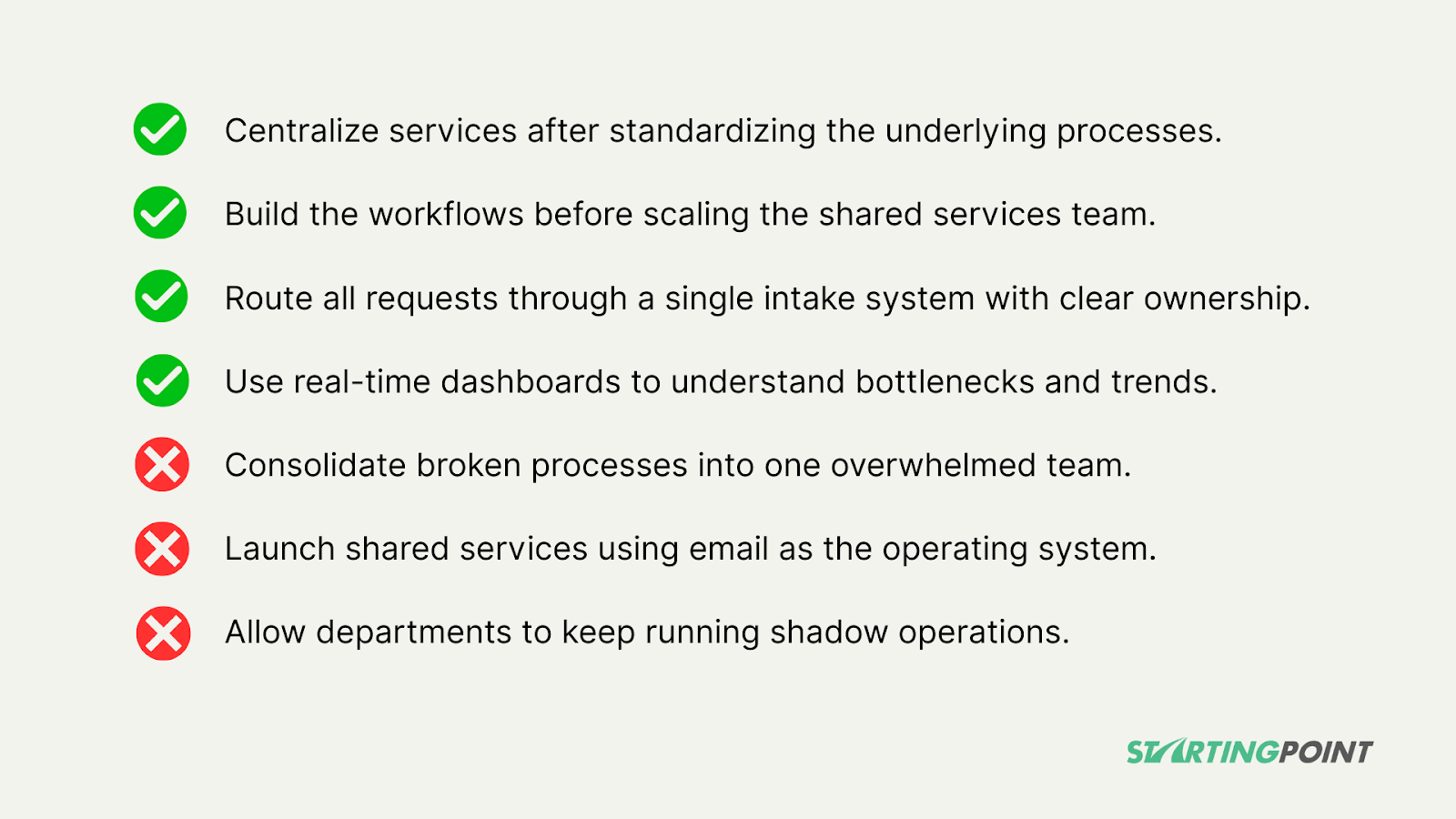
With this approach, you can centralize services after standardizing the underlying processes.
I'm interested in solving operational challenges that persist despite talented people and good intentions, which is exactly why I built StartingPoint after watching shared services organizations struggle with identical issues.
Teams spent more time managing requests through email and spreadsheets than actually resolving them. Organizations lost institutional knowledge when key people left because procedures existed only in individual memories.
Leadership made decisions about staffing and priorities based on whoever complained loudest rather than actual data about service delivery performance.
For me, spending two decades implementing complex enterprise systems at companies like Verisign, Neustar, and State Farm Insurance revealed a better way. One that didn't require six-figure investments and year-long implementations typical of enterprise software.
StartingPoint operates as an all-in-one workflow automation platform designed specifically for shared services and professional services organizations. Simple request management, automated workflows, knowledge bases, service level agreement tracking, resource scheduling, file storage, and team communication combine in one platform that deploys in under 10 minutes.
Automated rules with templates streamline request intake, task assignment, and status notifications across your team and with internal customers. Submitting an IT support ticket triggers StartingPoint to automatically route it to available specialists, set priority based on urgency, notify the requester of expected resolution time, and escalate if response standards aren't met.
Track and respond to internal customer requests while measuring satisfaction. Every inquiry gets logged, assigned, and monitored for timely resolution with full visibility into response performance and quality scores.
Assigning work to team members who have available capacity based on current workload becomes simple. Stop overloading your top performers while others remain underutilized.
StartingPoint reveals exactly who has bandwidth before you make commitments to internal customers.
Empower employees to find answers independently through searchable knowledge bases and FAQ repositories. Reduce ticket volume by enabling self-service for common requests while reserving human attention for complex issues.
Automate tracking of response times and resolution commitments. Set escalation rules that trigger when requests approach SLA breach thresholds. Generate compliance reports showing performance against service standards.
Understanding the health of your shared services operation happens at any time.
Dashboard views display request volumes by category, average response times, team utilization rates, service quality scores, and bottleneck identification. Compiling reports manually becomes obsolete!
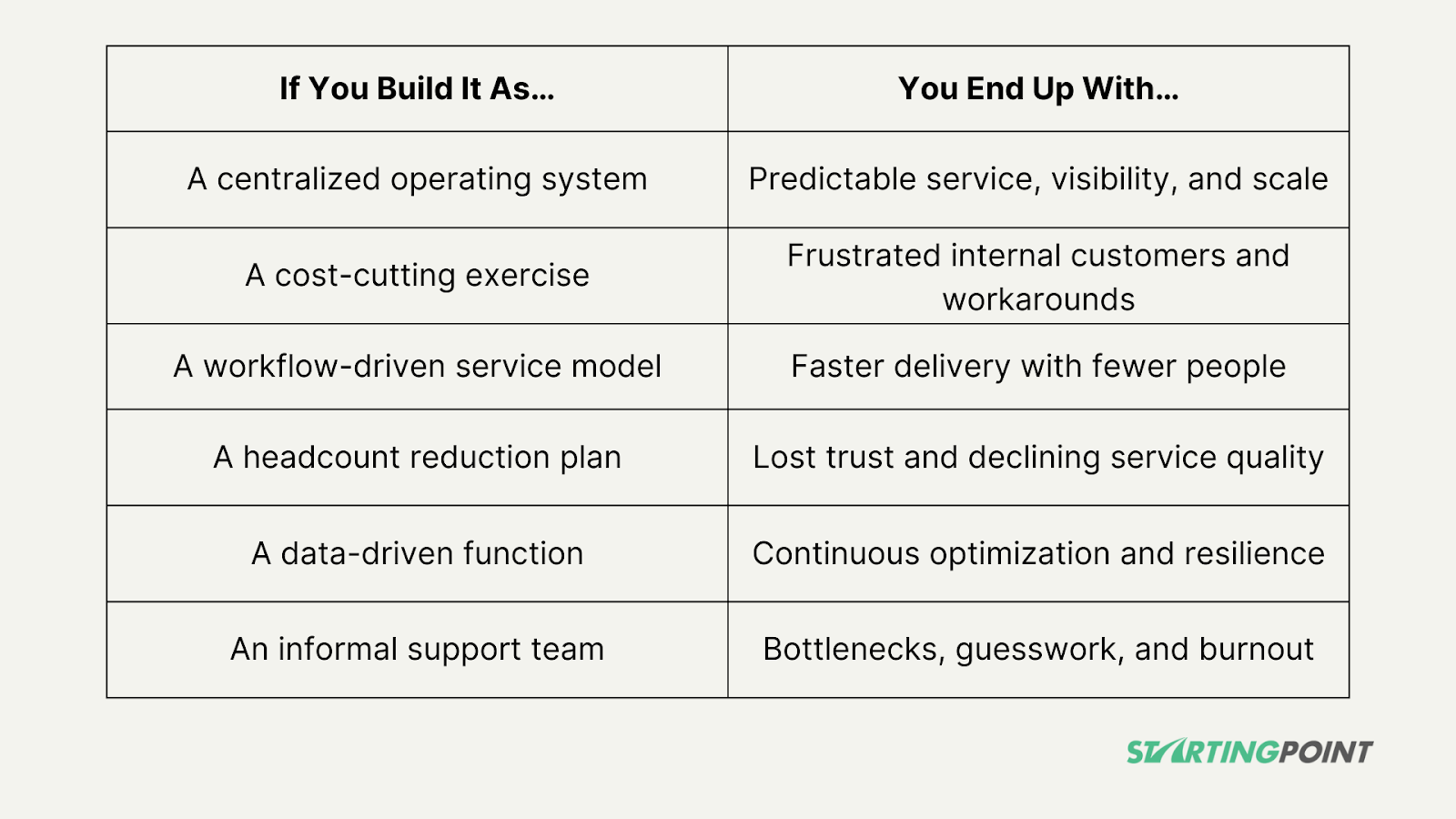
If you use a workflow-driven service model, you end up with faster delivery with fewer people.
Delaying the move to a centralized operating model compounds the disadvantage each quarter.
What I see repeatedly is this…
Centralizing administrative functions reduces duplication and creates economies of scale, while failing to do so leads to the same work being repeated across every location. When duplication is removed, teams serve more constituents, critical initiatives receive proper attention, and resources shift away from administration toward impact.
There are four immediate outcomes:
Freeing teams from administrative overhead changes how work gets done. Focus increases when people spend time on meaningful activities instead of maintaining parallel processes.
Companies implementing StartingPoint this month will enter next quarter with capabilities others will not achieve for years if they continue their current approach. Deployment takes under 10 minutes, requires no long implementation cycle, and produces measurable results within weeks.
Request your free trial of StartingPoint today and your team will thank you.


